
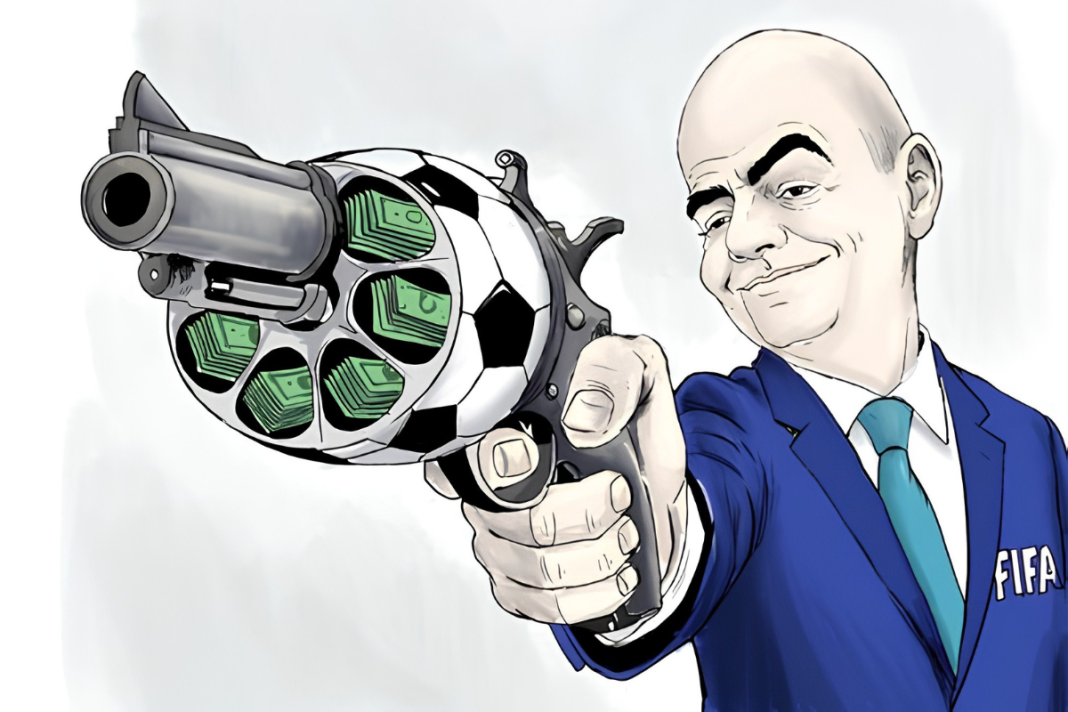
A closer look at why the president of world football has become the sport’s biggest public relations problem — and why the beautiful game deserves better.
Let me start with a simple thought experiment.
Imagine you are the CEO of the world’s most popular product. Not a product like an iPhone or a Tesla — I mean the most popular product in human history. A product loved by roughly 5 billion people across every continent, every religion, every political system, and every income bracket on Earth.
Now imagine that despite having this dream job — a job where all you really need to do is not mess things up — you somehow manage to make headlines every few months for saying something bizarre, cozying up to controversial regimes, or announcing a decision that leaves fans, journalists, and even your own member federations shaking their heads in disbelief.
Congratulations. You are Gianni Infantino, the president of FIFA.
And whether you love football, hate football, or barely tolerate football because your partner watches it every weekend, one thing is undeniable: under Infantino’s leadership, FIFA has gone from being a boring, bureaucratic organization to a full-blown source of international entertainment — and not the good kind.
Let’s talk about why.
First, a Little Background — Who Is Gianni Infantino?
Before we dive into the criticism, let’s give the man his proper introduction.
Gianni Infantino is a Swiss-Italian football administrator who became the 9th President of FIFA in February 2016. He took over after his predecessor, Sepp Blatter, was banned from football following one of the biggest corruption scandals in sports history — the infamous 2015 FIFA scandal that saw dozens of officials arrested in a dawn raid at a luxury hotel in Zurich.
At the time, Infantino was seen as a breath of fresh air. A reformer. A modernizer. A lawyer with a clean reputation who would restore FIFA’s credibility after years of embarrassment.
He promised transparency. He promised to grow the game. He promised to bring football to new corners of the world. He even promised — and this is important — to “put football first.”
Nearly a decade later, many people are wondering if he actually meant any of it.
Because instead of restoring FIFA’s dignity, Gianni Infantino has managed something almost impressive: he has made people miss Sepp Blatter.
Let that sink in for a moment.
Problem #1: The Awkward Speeches That Make Everyone Cringe
If you have never watched a Gianni Infantino press conference, do yourself a favor and watch just one. It is a strange, uncomfortable experience — like watching a family friend give a wedding toast that starts okay and then slowly veers into deeply personal territory that nobody asked for.
The most famous example, of course, is his infamous “Today I feel” speech delivered on the eve of the 2022 World Cup in Qatar.
Standing before a room full of international journalists, Infantino opened his remarks with these unforgettable words:
“Today I feel Qatari. Today I feel Arab. Today I feel African. Today I feel gay. Today I feel disabled. Today I feel a migrant worker.”
The speech went on for nearly an hour. In it, Infantino essentially compared the criticism Qatar was receiving over its human rights record to the bullying he supposedly experienced as a child in Switzerland for having red hair and freckles.
Yes. Really.
The reaction from journalists, human rights organizations, and football fans was swift and brutal. Human rights groups like Amnesty International and Human Rights Watch called the speech “crass” and “dismissive.” Journalists described it as one of the most tone-deaf performances they had ever witnessed from a sports administrator. Comedians, meanwhile, had a field day.
But here’s the thing — this was not an isolated incident. This was just the most visible example of a pattern that has defined Infantino’s presidency.
He has a peculiar habit of making things about himself. He has a strange tendency to lecture the world on morality while standing next to leaders with questionable records. And he has a completely tin ear for how his words land outside the marble halls of FIFA headquarters in Zurich.
Problem #2: The Awkwardly Close Friendships With Controversial Leaders
There is a certain unwritten rule in international diplomacy — if you run a global sports organization that claims to represent unity and fair play, you should probably keep a bit of professional distance from authoritarian leaders.
Someone forgot to send Gianni Infantino that memo.
Over the years, Infantino has been photographed in remarkably warm settings with a rotating cast of controversial political figures. He has appeared alongside Vladimir Putin, embraced Mohammed bin Salman, praised Recep Tayyip Erdoğan, and cozied up to numerous other leaders who are not exactly winning any awards from press freedom organizations.
Most notably, in the lead-up to the 2022 World Cup in Qatar, Infantino did something almost no other major sports executive would consider — he actually moved his family to Doha. Not for a business trip. Not for a diplomatic visit. He literally packed up and relocated to Qatar for the duration of the tournament.
Now, on the surface, one could argue this shows commitment. But critics — and there were many — saw it as something more troubling. They saw it as the president of a global sports body openly embedding himself with a host nation that had been widely criticized for its treatment of migrant workers, its restrictions on LGBTQ+ rights, and its overall human rights record.
To make matters worse, when journalists asked him about the estimated 6,500 migrant workers who reportedly died during the construction of Qatar’s World Cup infrastructure, Infantino’s response was to shrug off the criticism and talk about how much he had suffered from being ginger as a child.
You cannot make this stuff up.
Problem #3: The Ever-Expanding World Cup — More Isn’t Always Better
If there is one thing Gianni Infantino truly loves, it is expansion.
Under his leadership, FIFA has been on an aggressive mission to make every tournament bigger, longer, and more crowded than ever before. On paper, this sounds great — more football for everyone!
In reality, it looks a lot more like a cash grab dressed up in the language of inclusivity.
Let’s look at the changes:
The 2026 World Cup — held jointly in the USA, Canada, and Mexico — will expand from 32 teams to 48 teams. That’s an increase of 50%. The tournament will feature 104 matches instead of the traditional 64. The format has been so heavily criticized by coaches, players, and analysts that FIFA had to revise the group stage structure not once, but twice.
The Club World Cup has been transformed from a small, mostly ignored annual tournament into a bloated 32-team monster to be held every four years, with the first edition scheduled for the summer of 2025 in the United States.
Players’ unions like FIFPRO have openly protested, warning that footballers are being pushed to the brink of physical and mental exhaustion. Jürgen Klopp, the legendary former Liverpool manager, called the new Club World Cup “the worst idea ever invented in football.” Manchester City’s Rodri, who was later crowned Ballon d’Or winner, publicly said players were considering going on strike because of the workload.
Infantino’s response? Basically, “Football is growing, and we must grow with it.”
The problem is, nobody outside of FIFA’s boardroom seems to want this growth. Not the players. Not the coaches. Not the clubs. Not the leagues. Not even most of the fans, who are increasingly bewildered by the endless calendar of matches, tournaments, and tournaments-within-tournaments.
But growth means money. And money means power. And power, apparently, means keeping Gianni Infantino very happy.
Problem #4: The Saudi Arabia Situation — A Masterclass in Awkward Timing
If you want to understand modern FIFA under Infantino, you don’t need to look further than one country: Saudi Arabia.
Over the past few years, Saudi Arabia has become FIFA’s favorite dance partner. The kingdom is:
- The host of the 2034 World Cup (awarded in a process that raised eyebrows even by FIFA standards, as they were the only bidder after suspiciously convenient timing changes).
- The host of the FIFA Club World Cup 2023 and multiple other tournaments.
- A major sponsor through state-owned oil giant Aramco, which signed a massive multi-year deal with FIFA in 2024.
- The financial engine behind the ambitious Saudi Pro League, which has been signing global superstars like Cristiano Ronaldo, Neymar, and Karim Benzema at astonishing prices.
Now, none of this would necessarily be scandalous on its own. Sports and money have always mixed. Countries have always used major events for soft power.
But the way Infantino has handled the Saudi relationship has been, to put it mildly, unusually enthusiastic.
The 2034 World Cup bidding process, in particular, was widely criticized as a formality dressed up as competition. FIFA quietly changed rotation rules to allow an Asian host. The bidding timeline was compressed. Australia, initially interested, dropped out citing impossible deadlines. And by the time the smoke cleared, Saudi Arabia stood alone as the only bidder.
Human rights organizations were, once again, furious. Journalists asked hard questions. FIFA member federations from some European nations expressed serious concerns.
Infantino’s response? He praised Saudi Arabia’s “transformation” and its “vision for football.”
Meanwhile, human rights groups continued documenting concerns about migrant worker conditions, women’s rights, restrictions on free speech, and the treatment of political dissidents. Amnesty International warned that the World Cup was on a path to being built “on the exploitation of workers.”
But hey — the money is good, and Gianni is smiling. So apparently, everything is fine.
Problem #5: The Salary Scandal — Living Like a King While Preaching Solidarity
Nothing quite captures the modern FIFA vibe like the reports that emerged in 2024 about Gianni Infantino’s compensation.
According to FIFA’s own published financial reports, Infantino’s total remuneration reached approximately $5 million per year, including bonuses, benefits, and other perks. This is a significant increase from his salary when he first took the job in 2016.
Now, five million dollars is a lot of money for anyone. But it becomes especially eyebrow-raising when you consider a few things:
- Infantino spends a great deal of time lecturing the football world about “solidarity” and “redistribution of wealth” in the game.
- Many of FIFA’s member federations — particularly in Africa, Asia, and the Caribbean — operate on shoestring budgets and depend heavily on FIFA grants to survive.
- Infantino frequently talks about how football must serve “the world, not just the wealthy few.”
And yet, here he is, quietly cashing paychecks that would make most Fortune 500 CEOs blush, while flying around the world on private jets, staying in five-star hotels, and dining with royalty.
The optics are, to put it charitably, terrible.
Problem #6: The 2030 World Cup — A Logistical Nightmare Nobody Asked For
If you thought the expansion to 48 teams was the peak of FIFA’s chaos under Infantino, wait until you hear about the 2030 World Cup.
To celebrate the 100-year anniversary of the first World Cup (held in Uruguay in 1930), Infantino announced that the 2030 edition would be spread across six countries on three continents.
Yes. Six countries. Three continents.
The primary hosts are Spain, Portugal, and Morocco. But to honor the tournament’s centennial, three matches will also be played in Uruguay, Argentina, and Paraguay.
Sounds nice in theory, right? A beautiful celebration of football’s global reach.
In practice, it’s an environmental, logistical, and organizational disaster waiting to happen. Teams and fans will potentially need to fly across the Atlantic Ocean multiple times during the group stage. The carbon footprint will be enormous. The scheduling nightmares will be unprecedented. And the whole thing feels less like a celebration of football and more like a solution invented by someone who wanted to please as many federations as possible without actually thinking through the consequences.
But hey — it also conveniently opened the door for Saudi Arabia to host in 2034, because rules were changed to ensure the rotation “worked out.” Funny how that happened.
Problem #7: The Public Relations Disasters — A Greatest Hits Collection
Let’s take a moment to run through some of Gianni Infantino’s most memorable public moments — the ones that make communications experts around the world weep silently into their morning coffee:
- Posting an Instagram story from Davos talking about how much he loves flying private jets, right after preaching about sustainability.
- Giving a speech at the UN General Assembly that focused heavily on his own achievements at FIFA rather than the humanitarian topic at hand.
- Publicly hugging Vladimir Putin at the 2018 World Cup in Russia just months before Russia’s international standing collapsed.
- Announcing FIFA’s partnership with cryptocurrency company Algorand, only to see the crypto market crash and the deal quietly disappear from headlines.
- Casually suggesting that European players and fans should “apologize” for centuries of colonialism during a discussion about Qatar’s human rights record — a comment that somehow managed to offend both progressives and conservatives at the same time.
Each of these moments, taken individually, might be forgivable. Everyone makes mistakes. But taken together, they paint a picture of a leader who seems fundamentally unable to read the room.
The Bigger Picture — Why This Actually Matters
Now, you might be reading this and thinking, “Okay, the guy is annoying and says weird things. Why should I care?”
Here’s why it matters.
Football is not just a game. For billions of people around the world, it is a source of joy, community, identity, and hope. In slums from Rio de Janeiro to Dhaka, in refugee camps from Jordan to Kenya, in small towns from Argentina to Bangladesh, football is often the one thing that brings people together across every dividing line imaginable.
FIFA is the guardian of this global treasure. It is supposed to protect the sport, grow it responsibly, ensure fair competition, and — most importantly — represent the values that make football beautiful in the first place.
When the president of FIFA embraces authoritarian leaders, ignores human rights concerns, expands tournaments to the breaking point purely for profit, gives himself massive raises while preaching solidarity, and turns every press conference into an awkward personal monologue, it damages the sport itself.
It sends a message to the world that football’s leadership is more interested in power, money, and influence than in the game itself.
It tells the millions of young footballers dreaming of playing in a World Cup that the tournament they idolize might be held in a country where their basic rights would be violated.
It signals to journalists, activists, and reformers that FIFA is not a partner in progress — it is a bureaucratic machine that will always choose its own comfort over meaningful change.
And it slowly, quietly, chips away at the trust that fans have in the sport they love.
The Historical Parallel — Learning Nothing From Sepp Blatter
Perhaps the most frustrating thing about the Infantino era is how much it resembles the very thing it was supposed to replace.
Remember, Gianni Infantino got his job because Sepp Blatter’s FIFA collapsed under the weight of its own corruption and arrogance. Blatter was banned. Executives were arrested. Sponsors fled. The world demanded reform.
Infantino was supposed to be that reform.
Instead, we have watched a slow, uncomfortable evolution — not a revolution, but a rebranding. The suits are different. The smiles are wider. The speeches are more polished. But the fundamental dynamics remain the same:
- Cozy relationships with wealthy authoritarian regimes.
- Expanding tournaments primarily to generate revenue.
- Ignoring player welfare in favor of financial growth.
- Lecturing the world about values FIFA itself does not practice.
- A president who seems more interested in personal legacy than institutional integrity.
The names have changed. The chair has changed. But the culture, sadly, has not.
What Would Real Leadership Look Like?
To be fair — and this article aims to be fair — running FIFA is genuinely one of the hardest jobs in the world. You have to balance the interests of 211 member federations, deal with massive political pressure, manage billions of dollars, and satisfy fans, players, sponsors, and governments simultaneously.
Nobody would say this is easy.
But real leadership at FIFA would look something like this:
- Genuinely investigating human rights concerns in host countries, not dismissing them.
- Listening to players and coaches when they warn about fixture congestion, instead of ignoring them.
- Being transparent about executive compensation and spending.
- Standing firm with democratic values, even when it costs FIFA money.
- Speaking less and doing more.
- Understanding that the president of FIFA should serve the game, not the other way around.
None of these things are impossible. They just require a certain kind of leader — one who is willing to be less popular in some rooms in order to be more respected across the world.
Gianni Infantino, unfortunately, has shown time and again that he prefers being popular in the wrong rooms.
The “Personal Brand” of the FIFA President
Another reason Infantino creates a negative impression is the sense that FIFA has become too closely connected to his personal brand.
He is constantly visible. He gives speeches, attends political events, appears with world leaders, announces major plans, and speaks about the future of football in grand terms.
Visibility can be useful. A leader must communicate.
But there is a difference between communicating a vision and making the institution feel like a personal campaign.
FIFA should be bigger than any president. Its decisions should come from clear systems, independent committees, transparent processes, and accountable officials. If the president becomes the main character in every story, the institution can begin to look less stable.
Infantino often presents himself as the leader who understands football’s global future. He talks about bringing the sport to more countries and ending the dominance of a few traditional powers.
That vision appeals to many nations outside Europe. FIFA’s smaller federations often support him because they believe he gives them more attention and more opportunities.
But critics say the same strategy also helps him build political support. More members, more tournaments, and more funding can create a powerful network of allies.
That does not automatically mean the policy is wrong. It does mean people deserve to know whether decisions are designed primarily for football development or political survival.
A president who is loved by national associations but distrusted by fans has a serious public-relations problem.
Is Infantino Being Unfairly Blamed?
It would be unfair to blame Infantino for every problem connected to FIFA.
Some controversies began before he became president. The decision to award the 2022 World Cup to Qatar was made in 2010. Many problems involving labor rights and host-country politics existed long before Infantino entered office.
FIFA is also a complicated organization. It is not a government, even though it sometimes behaves like one. It does not control every decision made by clubs, leagues, national associations, or host countries.
Infantino has also achieved some genuine successes:
- More countries have gained access to World Cup competition.
- Women’s football has received larger investments and wider exposure.
- FIFA has increased development funding in many regions.
- Football has become more commercially successful.
- Smaller federations have gained a stronger voice in international politics.
- The organization has introduced formal reform measures after the corruption crisis.
These accomplishments should be recognized.
The criticism is not that Infantino has done nothing good. The criticism is that his leadership often makes FIFA look less trustworthy than it should.
He has a talent for turning good news into arguments and difficult questions into political speeches. He frequently appears determined to win every conversation, even when the best response might be to listen.
That is the difference between being powerful and being persuasive.
What FIFA Needs to Do Better
If Infantino wants to improve his reputation and restore public confidence in FIFA, the solution is not another slogan. It requires visible, practical changes.
1. Make host-country decisions more transparent
FIFA should publish detailed evaluation reports before awarding major tournaments. These reports should include human-rights assessments, labor protections, environmental plans, financial details, and risks to fans and players.
The public should not have to discover the weaknesses after the decision is final.
2. Strengthen independent oversight
Ethics committees must be genuinely independent. Investigations should not depend on personal relationships or political pressure. Meetings involving senior FIFA officials and government representatives should be documented and disclosed when appropriate.
Transparency should be automatic, not a favor.
3. Put player welfare first
Before adding new tournaments, FIFA should consult player unions, medical experts, clubs, leagues, and national teams. The organization should set limits on the number of matches players can reasonably play.
Football is a sport played by human beings. That basic fact should not become controversial.
4. Stop using football as a shield
Football can unite people, but it should not be used to avoid serious questions. FIFA must be willing to discuss labor rights, discrimination, corruption, and political influence directly.
A slogan about unity is not a substitute for accountability.
5. Communicate with humility
Infantino does not need to win every press conference. He does not need to answer every criticism with an attack. Sometimes the strongest response is simple:
“We made a mistake. We need to improve. Here is what we will do.”
That sentence would probably surprise FIFA’s communications department, but it might also help.
6. Protect the independence of the institution
FIFA should not appear to belong to one president, one government, one region, or one group of sponsors. The organization must show that its rules apply consistently, regardless of money or political influence.
The public should see FIFA as a global sports body, not a private club for powerful people.
A Final Assessment
Gianni Infantino did not create every problem at FIFA. He inherited an organization damaged by years of corruption, secrecy, and poor decisions.
But he has not completely escaped the old image.
His leadership has produced real development and global expansion, yet his communication style and political relationships have often made FIFA look defensive and overly commercial. His handling of Qatar, the OneLove armband controversy, tournament expansion, host-country decisions, and transparency questions has led many people to believe that FIFA cares more about influence and revenue than accountability.
That perception may not tell the whole story. But perception matters.
In football, a goalkeeper can make ten excellent saves and still be remembered for one mistake. FIFA is experiencing something similar. It may be doing valuable work in many areas, but every controversial decision adds to an old public memory: the belief that football’s leaders are playing a different game from everyone else.
Infantino has tried to present FIFA as modern, global, inclusive, and ambitious. The challenge is convincing people that ambition is not replacing responsibility.
Football fans are not asking for perfection. They understand that international sports involve money, politics, difficult compromises, and imperfect countries.
What they want is honesty.
They want FIFA to explain its decisions clearly. They want human rights to matter even when they are inconvenient. They want players treated as people rather than content. They want leaders who can accept criticism without turning every question into a political fight.
Most of all, they want the organization to remember why it exists.
FIFA does not own football. It administers it on behalf of the people who play, watch, support, and love the game.
That includes children playing on dusty fields, fans saving money for one ticket, women fighting for equal respect, players risking their bodies every weekend, and communities that see football as a part of their identity.
If Infantino can reconnect FIFA with those people, his legacy may improve.
If he continues to surround the sport with grand speeches, secretive decisions, political friendships, and endless tournament expansion, the negative impression will remain.
And football will continue to ask the same uncomfortable question:
Is FIFA serving the game—or is the game serving FIFA?
Editorial Note
This article discusses public criticism and perception surrounding Gianni Infantino and FIFA. It does not claim that every allegation against FIFA officials has been legally proven. Some investigations were closed without conviction, and several issues remain politically and legally disputed. Readers should consult current reporting from Reuters, the Associated Press, BBC, FIFA’s official documents, Human Rights Watch, Amnesty International, and FIFPRO for updated information.