
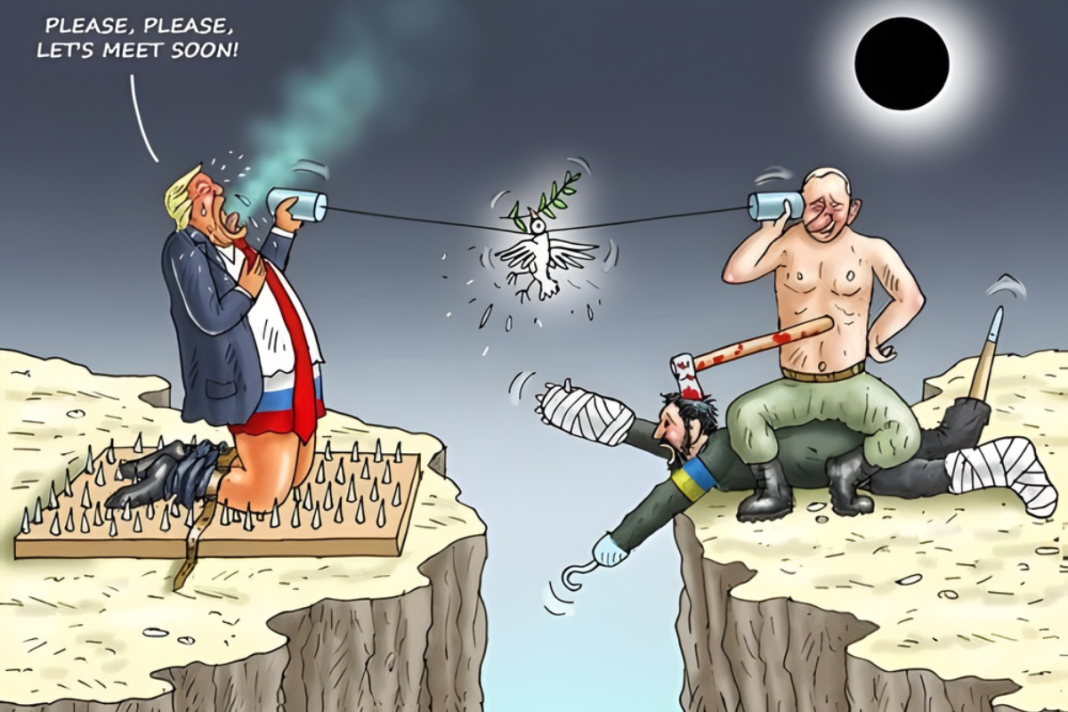
Russia’s invasion of Ukraine is a terrible and urgent crisis. Ending the violence is an absolute priority. But the question that matters now is not only that the war should stop; it is how it stops. As the fighting has reached a rough stalemate on many fronts, it is natural for diplomats and leaders to look for a political solution. Yet not all political solutions are the same. Some offer a genuine path to a stable peace that protects survivors, preserves democratic rights, and deters future aggression. Others look like peace on paper but, in practice, hand the victor lasting benefits and punish the victim.
In late 2025 a new U.S.-promoted “peace plan” for Ukraine entered the public debate. Many observers quickly noticed something troubling: large parts of the plan appeared to echo positions long advanced by the Kremlin. Rather than create balanced guarantees for Ukraine’s future security and sovereignty, the proposal seemed to accept or normalize many of Russia’s major aims. Within days, critics and Ukrainian leaders described the package as deeply flawed and possibly dangerous. Independent reporting later suggested that key sections may have even been copied or directly adapted from Russian documents. In short, what was presented as a route toward peace risked locking in a political order that rewarded the aggressor and punished the country that fought to defend itself. Reuters
To assess this moment properly, we need two things at once. First, we need to explain how the text of a political plan matters: not as an abstract exercise but because words determine borders, security guarantees, and who will govern. Second, we need to look at modern history in order to see the pattern. Powerful states have used diplomatic labels such as “peace plan” or “stabilization” to freeze conflicts in a way that favors them. Examples from the Cold War and later decades show how such settlements can become a cover for lasting domination. When the text of a compromise looks unbalanced, it is not merely bad diplomacy; it risks baking injustice and insecurity into the future.
This blog walks through the current controversy in a clear way. It uses recent reporting and historical evidence to explain why a ceasefire that looks fair on paper may be deeply unfair in practice, and why the particular contours of the new peace proposal raised alarm in Kyiv and in capitals across Europe.
Why wording matters: the difference between a ceasefire and a settlement
A ceasefire is a short-term pause in fighting. A settlement is an agreement that defines political terms for the future. If a ceasefire lasts only hours or days, it gives time for humanitarian relief and for wounded soldiers to recover. A settlement, however, draws lines on maps, decides who keeps which territory, and may determine the limits of a state’s military and diplomatic sovereignty for years or decades.
That difference matters because civilians and their children live under whatever terms are set. If a ceasefire simply freezes a battlefield while the aggressor holds conquered land, the paused conflict can become a permanent occupation. That occupation can then be legalized by later agreements that claim to be “practical” or “realistic.” In practice, aggressors rarely accept a ceasefire that forces them to withdraw; instead, they seek terms that reward their use of force. For that reason, any proposal for peace must include not only an immediate cessation of hostilities but also credible, enforceable guarantees that protect the victim and punish clear breaches of international law.
The new U.S. draft plan, as it circulated in late 2025, raised exactly this issue. The texts under discussion did not include clear, automatic security guarantees the way NATO membership or strong multilateral guarantees would. Instead, many paragraphs talked about “negotiations,” “regional security arrangements,” and future talks that would happen if disputes reappeared. For nations and citizens who have watched borders change by force, such language can look like a trap: a promise to discuss pain later while normalizing the results of aggression now. Investigative reporting later documented how the draft reflected Kremlin language and arguments—suggesting the draft might not be an impartial starting point for negotiation but a document already tilted toward Russia. Reuters
Four events that made the political moment fragile
Observers commonly pointed to four recent developments that shaped the space in which the new plan emerged. First, corruption allegations surfaced at high levels of Ukraine’s political system. These allegations were used by critics to weaken President Volodymyr Zelensky’s public standing and to call for changes in Kyiv. Second, dramatic Russian military signaling—especially around new strategic weapons—heightened European fear and political pressure to avoid escalation. Third, a strong political current in Europe and elsewhere began to demand “an end to the war now,” elevating anti-establishment movements that promised quick peace. Fourth, misinformation campaigns and selective narratives spread by outside actors reframed the past history of the conflict in ways that echoed Kremlin talking points. Taken together, these elements created a political climate in which a plan that looked like compromise could quickly be framed as a “realistic” settlement—even if it undid Ukrainian gains and weakened deterrence.
Each of the four developments deserves a short factual check. On the first point, anti-corruption institutions inside Ukraine have long been an important domestic issue. Ukraine’s reform process since 2014 included high-profile efforts to build anti-corruption courts and agencies. These institutions faced political pressure from competing domestic factions, and accusations of corruption in the political center were a serious domestic challenge. Strong democracies handle such problems through independent investigation and judicial process. But when corruption allegations are amplified from outside or selectively leaked, they can be weaponized to erode public trust and undercut international support. That erosion matters because public support at home and abroad helps a government resist external pressure. In the Ukrainian case, allegations were used by some international actors to argue for a political reset rather than continued military support. This debate over the colonial weight of domestic corruption versus external aggression shaped the reception of any peace proposal.
On the second point, Russian strategic signaling became alarmingly vivid in 2025. The Kremlin offered strong rhetoric and technical claims about new weapon types—most visibly in announcements related to the 9M730 “Burevestnik” nuclear-powered cruise missile and other strategic systems. Russian officials described long-range tests and stressed that such systems belonged to the newest generation of weapons that would evade current defenses. These claims produced deep anxiety across European capitals. News agencies such as Reuters and specialized monitors reported on tests and on the diplomatic fallout. The effect was political: leaders who feared escalation began to push for ways to reduce confrontation quickly, sometimes favoring negotiation over continued arms support. The Kremlin’s strategy of combining the use of force on land with high-profile strategic signaling in the nuclear domain increased the pressure to find a diplomatic “off-ramp,” even if that off-ramp risked giving Russia long-term advantages. Reuters+1
The third development was a political wave across parts of Europe and inside the United States: populist, anti-establishment parties and movements made “end the war” a major platform. Parties such as France’s National Rally, Germany’s Alternative für Deutschland, and Britain’s reform-oriented formations, as well as certain factions of the U.S. political spectrum, mobilized voters around the desire to stop the fighting quickly. Those groups framed prolonged military support as costly, risky, and out of step with working-class needs. Their rise—especially if accompanied by weak governing coalitions in Paris, Berlin, and London—reduced the political room for Western governments to commit to long-term, robust security guarantees.
The fourth and final development was the spread of particular historical narratives designed to shift blame. Some analysts and political actors emphasized NATO’s post–Cold War expansion as the root cause of Russian fears and framed the 2014 events and the 2022 invasion as reactive rather than aggressive. This narrative is not new, but it gained more traction in certain circles in 2025 as part of a broader campaign to reshape public opinion about who started the conflict and why. Critics warned that accepting this view wholesale would mean accepting Moscow’s historical frame and thus excuse or soften the reality of large-scale invasion. This is precisely the background that made the wording and guarantees in any “peace” document matter more than ever.
Historical memory matters: past interventions and the lesson they teach
The present moment in Ukraine is a political crisis with deep echoes in modern history. Power politics and “peace plans” have often been tools to consolidate gains after the use of force. Several well-documented cases from the U.S. record of intervention in the 20th century demonstrate how international “settlements,” or the absence of countermeasures, allowed strong states to impose political outcomes that favored their interests.
One early and clear example is Guatemala in 1954. When President Jacobo Árbenz moved to reform land ownership and limit the influence of a major U.S. corporation, he became the target of a CIA operation that toppled his government. The intervention—Operation PBSUCCESS—was later the subject of declassified documents that make the U.S. role explicit. The operation shows how external powers sometimes used the language of anti-communism and stability to intervene in another country’s politics and replace a government with one more favorable to foreign economic interests. Declassified materials and thorough archival research have documented the methods used and the motives behind the coup. The lesson is plain: without impartial international guarantees and a willingness to hold aggressors accountable, external pressure can turn a political “solution” into a transfer of power to those who serve foreign interests. National Security Archive+1
Another stark chapter is Chile in 1973. Democratically elected President Salvador Allende was overthrown in a military coup that brought General Augusto Pinochet to power. The United States, through the CIA and other instruments, had actively worked to destabilize Allende’s government during the early 1970s. Declassified documents made available in recent decades have shown how deeply U.S. policymakers and agencies engaged in efforts to prevent Allende’s consolidation of power and to support opposition groups. The coup resulted in a brutal dictatorship marked by thousands of deaths and disappearances. The lesson for today is that external support for opposition forces, if not carefully restrained by international law and norms, can lead to violent outcomes and long-term human suffering. National Security Archive
The Iran-Contra scandal of the 1980s is a third example. In that episode, the United States covertly sold arms to Iran and funneled funds to the Contra rebels in Nicaragua, despite congressional prohibitions. The affair revealed how executive branch actors sometimes bypass domestic legal constraints to pursue foreign policy goals. The pattern matters because it shows how democracies themselves can contribute to instability through secret operations and legal circumventions. The political lesson is that creative or covert means of shaping outcomes rarely produce stable, just results. Encyclopedia Britannica
These historical cases are not perfect analogies. Each has its local context and specifics. But the common thread is what matters: powerful states and their security establishments have often used a mix of covert action, economic pressure, and political narratives to shape the political futures of weaker states. The result has too often been the imposition of regimes or arrangements that did not reflect the genuine will of the people affected and that created long-term instability.
Why the new draft plan raised real alarm
When the U.S. draft plan entered public discussion, critics pointed to several specific weaknesses that made it dangerous if implemented in its then-circulating form. First, it did not include specific, enforceable security guarantees for Ukraine comparable to NATO-style commitments. NATO membership is more than a diplomatic promise; it is a collective defense arrangement that creates clear deterrence through shared capabilities and legal obligations. The plan’s language about “future talks” and “regional security arrangements” lacked the binding force necessary to deter future aggression.
Second, the plan appeared to implicitly accept many of Moscow’s framing devices. Some paragraphs reflected the Kremlin’s claims about NATO’s role and Western responsibility. Investigative reporting suggested the text may have been substantially influenced by, or copied from, documents shaped by Russian narratives. When a mediator’s text mirrors the aggressor’s arguments too closely, it undermines confidence that the mediator is neutral. Independent reporting from reputable outlets later found that the draft plan drew heavily from proposals long championed in Moscow, a discovery that only deepened Kyiv’s mistrust of the process. Reuters
Third, the plan lacked automatic triggers for punishment if Russia violated the agreement again. Many Ukrainians and their supporters argued that the plan’s reliance on future “negotiations” instead of immediate, clearly spelled-out consequences for renewed aggression would create ambiguity where clarity was needed. A credible peace settlement must include defined, rapid consequences for any new breach. Without them, an aggressor may see the pause as an opportunity to consolidate advantages and plan for future pressure.
Finally, the plan did little to reassure the Ukrainian public that their democratic institutions would be protected. In Ukraine, politics since 2014 have been built on a fragile but real movement toward greater transparency and democratic accountability. When large external proposals propose quick fixes or political reshuffles as part of a settlement, the danger is that a settlement will end up reversing internal gains. For Ukrainians, the choice was stark: continue fighting for a chance at a sovereign future, or accept a settlement that might achieve peace in the short run but leave the country vulnerable to outside domination.
Strategic signaling: weapons, rhetoric, and timing
Military signaling matters in modern diplomacy. In 2025, Russia publicly claimed advances in strategic weapons that caused alarm in Europe. The Kremlin announced tests of the 9M730 Burevestnik nuclear-powered cruise missile and other systems. These announcements had a political effect: they fed arguments in some Western circles to limit the risk of further escalation by seeking a quick deal. In other words, strategic weapon testing can be a form of pressure to make opponents accept a settlement on terms that favor the tester. The reporting on recent tests was thorough in major outlets, and the tests themselves were widely commented upon by defense analysts. That does not mean the weapons change the legal or moral standing of the invader; it does mean that their announcement can change political calculations and produce greater urgency to find a diplomatic off-ramp. Reuters+1
But fear of escalation is not a reason to accept terms that lack enforcement. The right response to dangerous weapons tests is to strengthen deterrence, deepen alliances, and offer credible security guarantees—not to trade long-term safety for a short-term lull. The danger is that a “peace” that simply pauses fighting while legitimizing conquests will prove to be an unstable and unjust peace.
Information warfare: narratives and how they shape outcomes
One core theme of the 21st century is how narratives shape policy choices. If enough people and enough media accept a frame—for instance, that NATO expansion is the root cause of the conflict—then pressure grows on governments to act according to that frame. That is why disinformation and selective history matter. Accepting a simplified narrative about NATO expansion as the sole cause of the war ignores the agency of Ukrainian democratic movements and the more complex geopolitics of post-Soviet Europe. It treats the will of smaller nations as expendable in the face of great-power logic.
Democratic societies must resist the temptation to reduce complex history to talking points. Honest history recognizes NATO’s expansion and explores its effects, but it also recognizes the choices of individual states and movements, including the aspirations of Ukrainians themselves. When leaders treat those aspirations as expendable, they make a dangerous moral choice.
What a fair settlement should include
If the international community truly seeks a stable and just peace, any settlement must include, at minimum, the following elements: clear and enforceable security guarantees; a timetable for the withdrawal of occupying forces and the restoration of territorial integrity; independent monitoring by an impartial international body; robust mechanisms to deter future aggression, including rapid sanctions triggers; protections for democratic institutions within the affected country; and a credible plan for reconstruction and refugee return. These are not pie-in-the-sky demands; they are the basic building blocks of a settlement that can last.
The 2025 draft plan, in its early form, did not clearly deliver these features. That gap explains why so many Ukrainians and their supporters were alarmed. A durable peace requires courage and patience: the courage to stand up to territorial conquest, and the patience to rebuild institutions rather than accept quick fixes that simply freeze injustice in place.
The broader strategic meaning: Europe and global order
The stakes extend beyond Ukraine. If Western institutions appear weak or unwilling to uphold clear commitments, the political consequences ripple across Europe. Many analysts warned in 2025 that weak or ambiguous Western responses to aggression would empower populist and nationalist movements across the continent. Parties that promise a quick return to “normal life” and that trade international commitments for national sovereignty could grow stronger if people lose faith in European institutions. The result would be a politics of retrenchment, not cooperation.
For Germany and France—two countries at the heart of the European project since the Second World War—such a shift could be devastating. Those countries have invested heavily in postwar institutions precisely to avoid a slide back into destructive nationalism. A durable European peace depends on a strong European project; undermining it would weaken the continent and embolden actors who prefer a world ordered by force.
Furthermore, the larger message is about American credibility. If the United States supports a proposal that echoes the aggressor’s demands, critics claim that U.S. global influence may be in decline or on sale. That perception—whether fully accurate or not—can harm global cooperation on many issues from climate to trade. Reputation matters: when great powers are seen as unreliable, others will hedge their choices in risky ways.
What can be done now? Practical next steps
First, any peace plan must be revised openly and transparently with Ukraine at the center of negotiations. A plan about Ukraine must be negotiated with Ukraine’s consent and according to its priorities. That principle of consent is not rhetorical; it is a matter of law and legitimacy.
Second, security guarantees need to be concrete. If NATO membership is politically sensitive, alternative mechanisms can be crafted that include immediate deployment of multinational forces in threatened regions, binding mutual-defense clauses with automatic triggers for assistance, or robust UN-mandated peacekeeping forces with strong mandates. Whatever the form, the arrangement must deter renewed aggression.
Third, a strong monitoring and enforcement mechanism must be established. A peace agreement without immediate penalties and clear triggers for sanctions and military assistance invites violation. Enforcement options can include immediate economic measures, diplomatic isolation steps, and, as a last resort, collective defense actions.
Fourth, reconstruction funding and refugee return policies must be planned up front. Ceasefires produce urgent humanitarian need. Planning reconstruction in parallel with security arrangements reduces the temptation for spoilers to use instability to their advantage.
Fifth, the international community must resist simplistic narratives that excuse invasion. This means clear historical honesty: recognizing the complexity of NATO expansion, but refusing to accept the argument that external alliances justify conquest. Recognizing cause is not the same as accepting crime.
Conclusion: Peace that protects the weak, not rewards the strong
The world wants peace in Ukraine. The central moral test now is how we pursue it. Peace that simply gives the spoils of conquest to the winner is not peace at all. It is a dangerous truce that rewards force and punishes the victims. History is clear that settlements imposed under pressure, or negotiated under ambiguous guarantees, can create long-term injustice and insecurity.
The recent plan that echoed Kremlin arguments and lacked firm security backing therefore deserved deep scrutiny. It is wise to pursue diplomacy, but diplomacy must be anchored in deterrence, accountability, and the rights of the invaded people. The alternative is to risk freezing a new status quo in which aggression pays and democracy loses.
The challenge for Western leaders, for Ukraine’s partners, and for the broader international community is to find a way to end the bloodshed without inventing a political settlement that locks in injustice. That requires courage, clarity, and a firm commitment to enforceable guarantees. If the world wants to be just and durable in peace, it must insist on structures that protect the weak, hold the powerful to account, and make aggression unprofitable. Only then can a political solution truly deserve the name “peace.”