
A Tale of Strategic Mistakes and Geopolitical Power
A Prophecy That Changed the World
In 1992, something important happened in a small city called Baotou in Inner Mongolia, China. Deng Xiaoping, one of China’s most powerful leaders, visited a large mining area. Standing there, looking at the vast landscape, he said something that would change the world: “The Middle East has oil, and China has rare earths.”
At that time, very few people understood what he meant. Even fewer realized that this simple statement would become one of the most important predictions in modern history. Today, more than three decades later, those words have come true in ways that even Deng himself might not have fully imagined.
This is the story of how America made a choice that seemed smart at the time but turned out to be one of its biggest strategic mistakes. It is also the story of how China saw an opportunity that others missed and turned it into a powerful weapon in the game of global politics.
What Are Rare Earths? The Invisible Foundation of Modern Life
Before we dive deeper into this story, we need to understand what rare earths actually are. The name sounds mysterious, and indeed, these materials are quite special.
Rare earth elements are a group of 17 special metals found in the middle of the periodic table. You cannot see them with your naked eye in everyday life, yet they are everywhere around you. They are the hidden foundation of modern technology.
Think about your smartphone. Inside that small device, there are rare earth elements helping the screen display colors, making the speaker produce sound, and allowing the phone to vibrate. Without rare earths, your phone would not work.
Consider electric cars, which are becoming more popular every day. The powerful magnets that make electric motors run smoothly depend on rare earth elements. Wind turbines that generate clean electricity from the wind also need these special metals.
But it does not stop there. Military drones that fly in the sky, advanced fighter jets that protect nations, radar systems that detect threats from far away – all of these depend on rare earth elements. In fact, almost every piece of modern technology, from computers to medical equipment, from robots to precision-guided missiles, needs these special metals.
Why Are They Called “Rare”?
Here is an interesting fact: rare earth elements are not actually that rare. They exist in many places around the world. So why do we call them “rare”?
The answer lies in how they exist in nature. These metals are usually mixed with other minerals and scattered throughout the earth. They rarely appear in pure form or in concentrations that make them easy and profitable to extract.
Imagine trying to find specific grains of sand on a beach. The grains are there, but they are mixed with millions of other grains. Separating them is difficult, time-consuming, and expensive. This is similar to how rare earth elements exist in nature.
The process of extracting and purifying rare earths is complicated, costly, and harmful to the environment. This difficulty is exactly what makes them so valuable and strategically important.
The Historical Shift: How America Lost Its Lead
The story of rare earth elements in the modern era begins in the United States. Many people today do not know this, but America was once the world’s leading producer of rare earths.
America’s Golden Era
Through the 1980s, the United States dominated rare earth production. American companies had the technology, the expertise, and the resources. They supplied rare earths to the world, and this gave America both economic profit and strategic control over a critical resource.
The Mountain Pass mine in California was the crown jewel of American rare earth production. It was one of the largest and most productive rare earth mines in the world. American scientists and engineers had developed sophisticated methods for extracting and processing these valuable materials.
Everything seemed perfect. America had control over a resource that was becoming increasingly important for technology and defense. What could possibly go wrong?
The Environmental Challenge
In the late 1980s and through the 1990s, something changed. People became more aware of environmental issues. Governments began passing stricter environmental protection laws. This was generally a good thing – protecting nature and human health is important.
However, rare earth processing is inherently dirty and dangerous. The chemicals used in extraction and purification can pollute water and soil. Radioactive materials are sometimes present alongside rare earths, creating additional hazards. Proper processing requires expensive safety measures and waste management systems.
As environmental regulations became more stringent in the United States, the cost of rare earth production increased dramatically. Companies found it harder and harder to make a profit while following all the new rules.
The Fatal Decision
Faced with rising costs and environmental challenges, American companies and policymakers made a decision that seemed logical at the time: let someone else do the dirty work.
China was willing to take on rare earth production. Chinese environmental regulations were less strict, labor was cheaper, and the Chinese government was eager to attract investment and develop new industries.
So, gradually, American companies began moving their rare earth operations to China or simply buying rare earths from Chinese suppliers instead of producing them domestically. The Mountain Pass mine eventually closed. American expertise in rare earth processing began to fade as engineers retired and were not replaced.
At the time, this seemed like a win-win situation. America could get the rare earths it needed without the environmental mess, while China could develop a new industry and create jobs. Trade, after all, was supposed to benefit everyone.
But there was a problem with this thinking. America was not just outsourcing the production of ordinary commodities like toys or clothes. It was handing over control of materials that were absolutely critical for advanced technology and national defense.
It was a strategic mistake of enormous proportions, though few people realized it at the time.
China’s Long Game: Building an Empire on Rare Earths
While America was stepping back from rare earth production, China was moving forward with determination and vision. This was not an accident or a lucky break. It was the result of careful planning and long-term strategic thinking.
Deng’s Vision Becomes Reality
Remember Deng Xiaoping’s statement in 1992? “The Middle East has oil, and China has rare earths.” This was not just a casual observation. It was a strategic vision that the Chinese government took very seriously.
China’s leadership understood something fundamental: in the modern world, control over critical resources means power. Just as oil had been the most important commodity of the 20th century, giving immense power to those who controlled it, rare earths could be the most important commodity of the 21st century.
The Strategy of Patient Investment
China did not become dominant in rare earths overnight. It took decades of patient, consistent effort. The Chinese government was willing to invest heavily in an industry that was not immediately profitable.
In the early years, Chinese rare earth companies often lost money. The work was difficult, the environmental costs were high, and the global market was competitive. But the Chinese government kept supporting the industry with subsidies, favorable policies, and strategic planning.
Why would any government do this? Why invest so much in an industry that was not making money?
The answer is that China was playing a long game. They understood that sometimes you must lose money in the short term to gain strategic advantages in the long term. They were building capabilities and infrastructure that would give them control over a critical resource in the future.
Building a Complete System
China did not just focus on mining rare earths. They built an entire ecosystem around these materials.
First, they developed mining operations across the country, particularly in Inner Mongolia where rare earths are abundant. They invested in the technology and equipment needed for efficient extraction.
Second, they built refining and processing facilities. This is actually the most difficult and important part. Raw rare earth ores must be processed through complex chemical procedures to separate and purify the individual elements. China became the world’s expert in this challenging work.
Third, they developed manufacturing industries that use rare earths to make magnets, catalysts, and other products. This meant that China not only produced the raw materials but also manufactured the finished products that contain them.
By building this complete system – from mining to refining to manufacturing – China created a rare earth empire that is extremely difficult for other countries to challenge or replicate.
The Numbers Tell the Story
Today, China’s dominance in rare earths is staggering. Let me give you some numbers that show just how much control they have:
- China possesses the largest rare earth reserves in the world
- They account for a huge portion of global rare earth mining
- They control the vast majority of rare earth refining and processing
- Nearly all advanced rare earth products, like powerful magnets, are made in China
This means that even if another country mines rare earths on its own soil, it often has to send them to China for processing because no one else has the necessary facilities and expertise at the required scale.
To put this in perspective, imagine if one country controlled almost all the world’s ability to refine oil. Even if other countries had oil wells, they would still need to send their crude oil to that one country for refining into gasoline, diesel, and other products. That is essentially the situation with rare earths and China.
The scale of this dominance becomes even clearer when you look at specific rare earth elements. For some of the most critical ones – like neodymium and dysprosium, which are essential for powerful magnets – China’s control is nearly absolute. These magnets are used in everything from electric car motors to wind turbines to military applications.
China spent more than four decades building this position. They accepted environmental damage that other countries would not tolerate. They made investments that seemed unprofitable. They played the long game while others focused on short-term costs and benefits.
And now, that patience has paid off in the form of enormous geopolitical leverage.
The Human Cost and Environmental Toll
While China’s strategic success with rare earths is impressive, it is important to acknowledge that this success came with significant costs, particularly environmental and human costs.
In Baotou, the city where Deng Xiaoping made his famous statement, there is a toxic lake that has been called one of the most polluted places on Earth. This lake, which locals call the “rare earth lake,” is where waste from rare earth processing is dumped. The water is a dark, unnatural color, and nothing can live in it.
Around rare earth mining and processing sites, there have been reports of increased cancer rates, crop failures, and contaminated water supplies. Workers in rare earth facilities have sometimes been exposed to dangerous chemicals and radiation without adequate protection.
This is the dark side of rare earth production, and it is part of why Western countries moved away from it. The environmental and health costs are real and serious. China’s willingness to bear these costs – often at the expense of its own people and environment – is part of what enabled its dominance in this industry.
In recent years, China has begun to recognize these problems and has started implementing stricter environmental controls. But for many years, the drive for economic development and strategic advantage took priority over environmental protection.
This raises profound questions about the true cost of modern technology. Every smartphone, every electric car, every wind turbine carries with it some of this environmental burden. When we outsource dirty production to other countries, we may feel that our hands are clean, but the environmental damage still happens – it just happens somewhere else, often in communities with less political power to resist.
The Wake-Up Call: When China Showed Its Hand
For many years, China’s dominance in rare earths was not seen as a major problem in Washington or other Western capitals. Yes, people knew China produced most of the world’s rare earths, but so what? China also made most of the world’s toys and clothes. It was just another example of global trade and specialization.
This complacent attitude changed dramatically in recent years, especially in 2025.
The Trade War and Rare Earth Retaliation
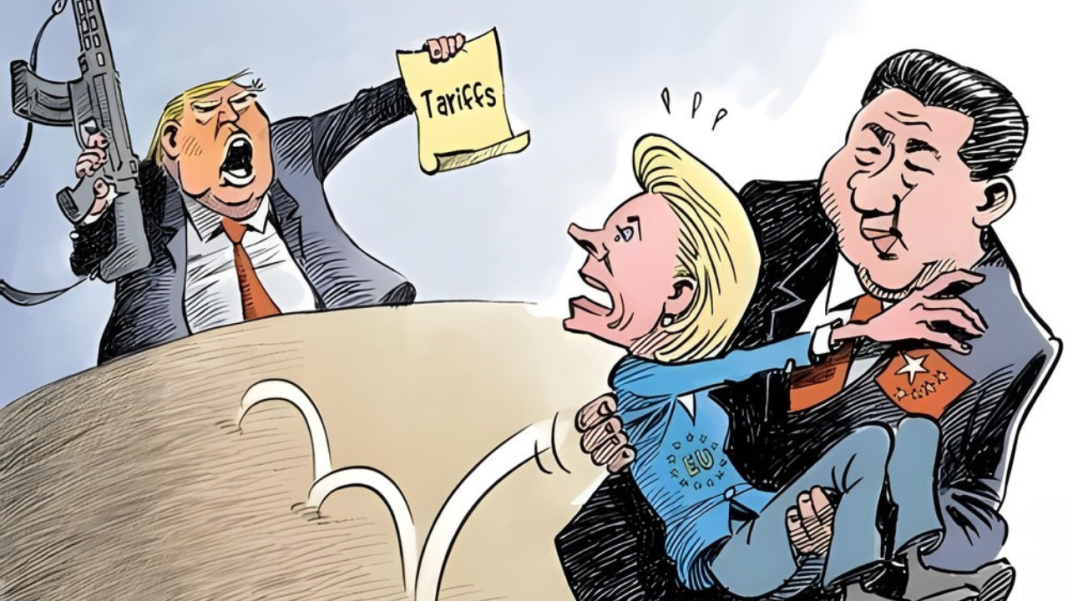
In April 2025, the United States imposed very high tariffs on Chinese goods. This was part of an ongoing trade dispute between the two countries. America was trying to protect its industries and reduce its trade deficit with China.
China’s response was swift and strategic. Instead of just imposing tariffs on American goods in return, China did something more targeted and more threatening: they announced restrictions on the export of certain rare earth elements and special magnets to the United States.
This was a relatively small move in economic terms. Rare earths represent a tiny fraction of total trade between China and the United States. But the impact was enormous because of where these materials are used.
The announcement sent shockwaves through Washington’s corridors of power. Defense contractors immediately began reviewing their supply chains and inventory levels. Technology companies started emergency meetings to assess their exposure. Government officials scrambled to understand the full implications of China’s move.
What made this action so effective as a pressure tactic was its precision. China did not need to cut off all trade or take dramatic action that would harm its own economy. By targeting just a few critical materials, they could create maximum strategic impact with minimal economic cost to themselves.
It was like a skilled martial artist who knows exactly where to strike to cause the most pain with the least effort. China had found a pressure point in the American economy and defense establishment, and they were not afraid to use it.
This moment represented a turning point in how American policymakers thought about economic interdependence and national security. For years, the prevailing wisdom was that economic integration between countries made conflict less likely – if we all depend on each other for trade, no one wants to disrupt the system.
But China’s rare earth move showed that interdependence can also be weaponized. If one side controls something critical that the other side needs, that dependence becomes a source of leverage and vulnerability, not just mutual benefit.
The Defense Dilemma
The panic in Washington was immediate and justified. American defense contractors suddenly realized they might not be able to get the materials they needed to build advanced weapons systems.
Consider the F-35 fighter jet, America’s most advanced military aircraft. Each F-35 contains about 920 pounds of rare earth elements. Without these materials, you cannot build this aircraft.
Or think about precision-guided missiles, the kind that can hit specific targets with incredible accuracy. These weapons rely on rare earth elements for their guidance systems.
Submarines, radar systems, satellite communications, missile defense systems – all of these critical military technologies depend on rare earth elements. And most of these rare earths come from China or must be processed in China.
Suddenly, American military planners faced an uncomfortable truth: their ability to defend the country depended on a potential adversary’s willingness to sell them critical materials.
This is what we call a strategic vulnerability, and it is a very serious problem.
Beyond Defense
But the problem extends far beyond the military. Rare earths are essential for civilian industries too.
Computer manufacturers need rare earths for hard drives and displays. The robotics industry needs them for motors and sensors. Medical equipment, from MRI machines to X-ray systems, uses rare earth elements. The entire renewable energy sector – wind turbines and solar panels – depends on these materials.
If China were to seriously restrict rare earth exports, it could potentially bring large parts of the American economy to a halt. Not immediately, of course – there are stockpiles and alternative suppliers for some materials – but over time, the impact would be severe.
This gives China enormous leverage in any dispute with the United States or other countries. It is a weapon that does not require firing a single shot.
Why Is This So Hard to Fix?
Once American policymakers realized the magnitude of the rare earth problem, the obvious question arose: why don’t we just start producing rare earths in America again?
The answer reveals why China’s strategic advantage is so powerful and so difficult to overcome.
It’s Not Just About Mining
Many people think the rare earth problem is simply about reopening mines. After all, rare earth deposits exist in the United States and many other countries. Why not just dig them up?
But mining is actually the easy part. The real challenge is processing and refining.
Remember, rare earth elements are mixed with other materials and with each other. Separating them requires sophisticated chemical processes that are technically difficult, environmentally challenging, and expensive to perform correctly.
China has been perfecting these processes for decades. They have the factories, the equipment, the technical expertise, and the trained workforce. They have established supply chains and relationships with customers around the world.
The Cost Factor
Building a rare earth industry from scratch or rebuilding one that has been dormant is incredibly expensive. You need to:
- Open or reopen mines and develop extraction methods
- Build processing facilities with sophisticated chemical systems
- Develop or rediscover the technical knowledge needed for refining
- Train workers in specialized skills
- Establish environmental safeguards and waste management systems
- Create relationships with customers and prove your products are reliable
All of this takes years and billions of dollars. And even when you finish, you will be competing with Chinese producers who have lower costs and decades of experience.
No private company wants to make this investment unless the government guarantees support, because the financial risks are too high. But government support means taxpayer money, which is always controversial.
The Time Problem
Even if America or another country decided to invest heavily in rare earth production today, it would take years – perhaps a decade or more – to build a complete rare earth supply chain that does not depend on China.
China took more than 40 years to reach its current position. It is unrealistic to think anyone else can achieve the same thing in just a few years, no matter how much money they spend.
This is why China’s strategic advantage is so durable. They have created a situation that cannot be quickly or easily changed, giving them lasting leverage in international affairs.
The Environmental Question Returns
There is another uncomfortable truth that makes the rare earth problem so difficult: production of these materials is genuinely harmful to the environment.
If America wants to rebuild its rare earth industry, it must accept environmental damage that communities may not want. Mining operations scar the landscape. Processing facilities generate toxic waste. Even with the best modern technology and regulations, there are environmental costs.
This creates a difficult political and moral question: how much environmental damage are we willing to accept for the sake of strategic independence? There is no easy answer to this question, and different people will have different views.
The New Reality: Rare Earths as Geopolitical Weapons
We now live in a world where rare earth elements have become tools of international politics and power. This represents a significant shift in how we think about natural resources and strategic advantage.
The Oil Parallel
Throughout the 20th century, oil was the most strategically important commodity in the world. Countries went to war over oil. Alliances were formed and broken based on oil supplies. Whoever controlled oil had enormous power.
The United States understood this well and worked hard to ensure access to oil, sometimes through diplomacy, sometimes through military means, and sometimes through alliances with oil-producing countries.
Now, in the 21st century, rare earths are becoming similarly important. They may not fuel our cars (though they help build electric cars), but they power our technology, our economy, and our military capabilities.
Just as Deng Xiaoping predicted, rare earths are to China what oil was to the Middle East – a source of wealth, leverage, and geopolitical power.
The Tech Cold War
The rare earth situation is part of a larger competition between China and the United States over technology and innovation. This has been called a “tech cold war,” and rare earths are a critical battlefield in this conflict.
The United States tries to limit China’s access to advanced computer chips and cutting-edge technology. China responds by threatening to restrict rare earth exports. Both sides are trying to control resources and technologies that are essential for economic growth and military power in the modern era.
This competition will likely define international relations for decades to come. And rare earths give China a powerful advantage in this competition.
The Multipolar World
China’s control over rare earths also reflects a broader shift in global power. For several decades after World War II, the United States was the dominant global superpower. American economic and military power was unmatched.
But the world is changing. Power is becoming more distributed. China, in particular, has risen to become a major economic and increasingly military power. The rare earth story is both a symbol and a cause of this shift.
By controlling rare earths, China has leverage not just over the United States but over many countries around the world. Europe, Japan, South Korea, and other advanced economies all depend on Chinese rare earths. This gives China influence over decisions these countries make about trade, technology, and even security.
In this new multipolar world, control over critical resources like rare earths becomes a form of power that can rival traditional military might.
What the Future Holds
As we look to the future, the importance of rare earth elements is likely to grow, not shrink. This is because of trends in technology and global priorities.
The AI and Automation Revolution
We are entering an era dominated by artificial intelligence and automation. Self-driving cars, intelligent robots, smart factories, advanced drones – all of these technologies depend heavily on rare earth elements.
The magnets in electric motors, the sensors that allow machines to perceive their environment, the components that enable precise control – many of these require rare earths.
As AI and automation become more widespread, demand for rare earths will increase. This will make China’s control over these materials even more valuable and strategically important.
The Green Energy Transition
Many countries are trying to move away from fossil fuels and toward renewable energy sources to combat climate change. This is a worthy goal, but it has an ironic consequence: it makes us more dependent on rare earths.
Wind turbines use rare earth magnets. Electric vehicles need rare earths for their motors and batteries. Solar panels use rare earth materials to improve efficiency.
The more we try to build a green economy, the more we need rare earths. And that means the more dependent we become on China.
This creates a strategic dilemma: how do you pursue environmental goals when doing so increases your dependence on a geopolitical rival?
The Search for Alternatives
Recognizing the rare earth problem, many countries and companies are now searching for solutions. These efforts take several forms:
Diversifying Supply: Some countries are trying to develop rare earth mines and processing facilities outside of China. Australia, Vietnam, and other countries have rare earth deposits that could be developed. But as we have discussed, this takes time and money.
The United States has made some progress in this direction. The Mountain Pass mine in California, which had been closed, was reopened and is now producing rare earth ore again. However, much of this ore is still sent to China for processing, which means the strategic vulnerability has not been fully addressed.
Other countries are also making moves. Australia, which has significant rare earth deposits, is trying to build its own processing capabilities. European countries are exploring rare earth potential in Greenland and Scandinavia. Japan has discovered rare earth deposits on its ocean floor, though extracting them would be technically challenging and expensive.
All of these efforts are positive steps, but they face significant obstacles. China can lower prices to make competition unprofitable. Environmental concerns still exist wherever rare earths are produced. And even if mining can be done outside China, the processing and refining often still depends on Chinese expertise and facilities.
Recycling: Old electronics contain rare earths. Some companies are working on better methods to recycle these materials from discarded devices. This could reduce the need for newly mined rare earths, but recycling alone cannot meet current demand.
Think about all the old smartphones, computers, and other electronic devices that end up in landfills or recycling centers. Each one contains small amounts of rare earth elements. If we could efficiently extract and reuse these materials, we could reduce demand for newly mined rare earths.
Several companies and research institutions are working on this. Some have developed processes to extract rare earths from electronic waste. Others are working on designs for new products that would make recycling easier – for example, devices where rare earth components can be more easily removed and reused.
However, recycling faces challenges. The amount of rare earths in each device is small, making extraction difficult. The processes can be expensive and technically challenging. And even if recycling becomes more efficient, it can only provide a fraction of the rare earths needed by industry.
Substitution: Scientists are researching alternative materials that could replace rare earths in some applications. There has been some progress, but for many uses, no good substitutes currently exist.
This is perhaps the most promising long-term solution, but also the most difficult. Rare earth elements have unique properties that make them extremely useful for specific applications. Finding materials that can do the same job is not easy.
For example, the powerful permanent magnets used in electric vehicles and wind turbines typically require neodymium and dysprosium. Scientists are working on magnets that use less of these rare earths or that use alternative materials entirely, but so far, nothing matches the performance of rare earth magnets at comparable cost.
In some applications, substitution has been successful. For lighting, LED technology has replaced bulbs that used rare earth phosphors. But for many critical applications, especially in motors and generators, substitution remains elusive.
Strategic Stockpiles: Some governments are building stockpiles of rare earth elements, buying and storing them for potential emergencies. This provides a buffer but does not solve the long-term problem.
The United States, Japan, and some European countries have established strategic stockpiles of certain rare earth elements. These stockpiles could provide supplies for several months or even a few years in case of supply disruptions.
However, stockpiling has limitations. It requires significant investment to purchase and store materials. The stockpiles need to be rotated to prevent degradation. And most importantly, stockpiles only buy time – they do not eliminate dependence on external suppliers for the long term.
International Cooperation: Some countries are trying to work together to reduce dependence on China. The United States, Australia, Japan, and others have discussed forming a “rare earth alliance” to share resources and expertise.
This approach recognizes that no single country can easily match China’s rare earth capabilities, but several countries working together might be able to create alternative supply chains. Different countries could specialize in different parts of the production process, creating a distributed but resilient system.
However, international cooperation faces its own challenges. Countries have different priorities and interests. Political changes can disrupt long-term plans. And coordinating across multiple countries is inherently more complex than having a single, integrated supply chain.
All of these approaches help at the margin, but none of them fundamentally changes China’s dominant position. That position is likely to persist for many years, perhaps decades.
The reality is that building alternative rare earth supply chains is like trying to recreate an entire ecosystem. China has spent 40 years developing not just mines and factories, but also technical expertise, trained workers, equipment manufacturers, quality control systems, customer relationships, and all the other elements of a mature industry. Replicating all of this elsewhere will take time, money, and sustained political will.
Lessons Learned: What This Story Teaches Us
The rare earth saga offers several important lessons about strategy, economics, and international relations.
Short-Term Thinking Has Long-Term Consequences
America’s decision to abandon rare earth production made sense in the short term. It reduced costs, avoided environmental problems, and seemed economically rational. But the long-term strategic consequences were severe.
This teaches us that we must think carefully about the long-term implications of economic decisions, especially when they involve critical resources or capabilities. Sometimes, what seems efficient in the market can create strategic vulnerabilities over time.
Not All Trade Is Equal
The theory of free trade suggests that countries should specialize in what they do best and trade with each other. This generally creates economic benefits. But the rare earth story shows that some trade involves more strategic risk than others.
Trading toys or textiles is relatively low-risk. If a supplier cuts you off, you can find another one without too much difficulty. But trading in rare earths – materials essential for advanced technology and defense – is different. Dependence on a single supplier for such critical materials creates strategic vulnerability.
This suggests that countries need to think carefully about which capabilities and resources are so critical that they should not be entirely outsourced, even if it would be more economically efficient to do so.
Vision and Patience Matter
China’s success in rare earths came from having a clear vision and the patience to pursue it over decades. They understood the strategic importance of these materials before most others did, and they were willing to make investments and accept costs to achieve dominance.
This kind of long-term strategic thinking is often difficult in democratic countries where political leaders face regular elections and must show short-term results. But the rare earth story shows the value of thinking and planning for the long term.
Environmental Protection Is Important, But So Is Strategic Security
The environmental problems associated with rare earth production are real and serious. America was right to be concerned about them. But the rare earth story also shows that environmental protection must be balanced with other concerns, including strategic security.
Perhaps the lesson is not that we should ignore environmental protection, but that we need to find ways to produce critical materials more cleanly and sustainably, even if it costs more. Strategic independence may be worth the extra expense.
A Weapon Forged by Default
We began this story with Deng Xiaoping’s prophecy: “The Middle East has oil, and China has rare earths.” That statement has proven remarkably prescient.
Through a combination of American strategic mistakes and Chinese strategic vision, rare earth elements have become a powerful weapon in China’s hands. It is a weapon that America essentially handed to China by walking away from rare earth production decades ago.
This weapon does not involve bullets or missiles. It operates through control of materials that are essential for modern technology, from smartphones to fighter jets. By controlling these materials, China has leverage over not just the United States but much of the developed world.
The rare earth situation is a reminder that power in the modern world comes from many sources. Military force remains important, but so does control over critical resources, technological capabilities, and supply chains.
It is also a reminder that strategic thinking requires looking beyond immediate costs and benefits to consider long-term implications. What seems like a smart economic decision today can create vulnerabilities tomorrow.
As we move further into the 21st century – an era defined by advanced technology, automation, and artificial intelligence – rare earth elements will only become more important. The country that controls these materials has an advantage in the race for innovation and economic growth.
China understood this decades ago and acted accordingly. The United States is now trying to respond, but reversing decades of neglect is difficult and will take many years.
The story of rare earths is not over. New chapters will be written as countries try to develop alternative sources, new technologies emerge, and the geopolitical landscape evolves. But for now, and for the foreseeable future, China holds the rare earth weapon – a weapon that America itself helped create.
In the great game of international power and strategy, control over small, nearly invisible metal elements has proven to be as important as control over vast oil fields or powerful armies. Deng Xiaoping saw this coming in 1992. Now, the whole world is living with the consequences of his vision and America’s oversight.
The question now is not whether rare earths are strategically important – that much is clear. The question is what the world will look like as we navigate a future where one country controls so much of a resource that everyone needs. That is the challenge of our time, and how we address it will shape the decades to come.